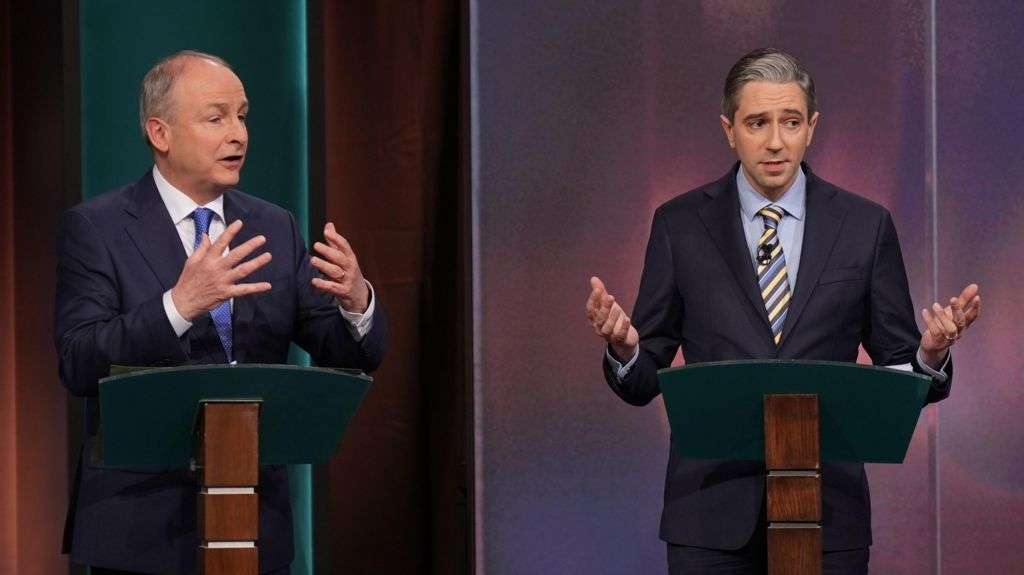
As the Irish general election draws nearer, two men who have been in government together since 2020 are now trying to put some distance between their parties in the eyes of voters.
Taoiseach (prime minister) Simon Harris's Fine Gael and Micheál Martin's Fianna Fáil formed a coalition with the Green Party after the last general election in February 2020.
As part of the agreement, the role of taoiseach was swapped between Fianna Fáil and Fine Gael mid-way through the scheduled five-year term.
But with polling day approaching, the leaders of both parties need to try to disprove opposition claims that they are now "two sides of the one coin".
The 2020 coalition came after Sinn Féin won the highest number of votes, but Fianna Fáil won the most seats in the Dail (parliament).
Both Fianna Fáil and Fine Gael have said they would not form a coalition with Sinn Féin.
The two men who led the outgoing Irish government grew up in very different times in Ireland.
Harris, born in 1986, was a 10-year-old schoolboy when the tánaiste (deputy prime minister) Martin became a government minister for the first time.
While the 38-year-old Fine Gael leader has enjoyed a meteoric rise, Martin's time in politics is marked by longevity.
Martin, 64, grew up in Cork and made his big political breakthrough in 1989 when he was elected to the Dáil.
He has led Fianna Fáil since 2011 and has extensive national and international experience as a minister in various Irish governments.
He served a two-and-a-half-year stint as taoiseach during the term of the outgoing coalition government.
Harris was born in County Wicklow and grew up at a time that the social fabric of Ireland was undergoing tumultuous change.
He was elected taoiseach earlier this year.
Martin is a veteran of Anglo-Irish relations.
This was reflected within days of the new British government being elected earlier this year when he met the new Northern Ireland Secretary of State Hilary Benn to "reset" troubled diplomatic relations.
Harris subsequently went to Chequers to meet the new prime minister, Sir Keir Starmer.
The improving Irish-British relations continued when Sir Keir made a return visit to Dublin.
Martin has a long history in cross-border politics, and he was instrumental in establishing a 'Shared Ireland' initiative to develop relationships and enhance co-operation between administrations on both side of the border.
Martin has also been a trenchant critic of IRA violence and Sinn Féin politics.
Since his election as taoiseach in March, observers have also been noting several high-profile interventions by Harris about events relating to both sides of the Irish border.
Twice in that time he has publicly rebuked people about how they used the Irish national flag.
'Take our flag back'
On the day he accepted leadership of Fine Gael, he lambasted those who used the flag at the funeral of Pearce McAuley.
McAuley was jailed for 14 years for the manslaughter of Detective Garda Jerry McCabe who was shot dead by an IRA gang in County Limerick in June 1996.
"In a week where I saw the tricolour of this republic draped over the coffin of a Garda killer, I say shame. Let's take our flag back," he said.
In the summer, he returned to the theme when activists from Dublin waved the flag during an anti-immigration protest in Belfast.
The protest was followed by rioting.
In recent weeks, he has been on the attack as Sinn Féin has struggled to explain and defend a series of controversies involving the party.
One of the most pointed interventions came after a satirical comment on an Irish TV chat show.
Sinn Féin demanded an apology from broadcaster RTÉ after presenter of The Late Late show, Patrick Kielty, used the term "the Sinn Féin traitors" during a broadcast at the height of the controversies.
The party claimed the term was "a slogan used by far-right activists in Ireland".
The following day, Harris said: "I noted how quick Sinn Féin were yesterday to seek an apology from RTÉ for a bit of satire.
"They haven't been as quick to respond to the teenager who was inappropriately contacted by a Sinn Féin senator."
Sinn Féin later apologised to the teenager.
On the international stage, the Irish government, under the leadership of Harris and Martin, has indicated that it intends to file a Declaration of Intervention in the case initiated by South Africa against Israel under the Genocide Convention at the International Court of Justice.
The government in Dublin previously "unreservedly condemned" what it described as the brutal attacks "by Hamas and other terrorist groups against Israel on 7 October 2023".
But this election will be fought mostly on so-called national bread and butter issues such as an ongoing housing crisis and hospital waiting lists, alongside basic family concerns around the cost-of-living.
Immigration will also be an issue.
Harris is hoping the so called 'Harris hop' - favourable opinion poll ratings since his election as leader - will help Fine Gael's prospects.
It could be one of the relatively young Fine Gael leader's trump cards over the next few weeks.
Meanwhile, Fianna Fáil will be hoping Martin will have enough reserves of political stamina to finish ahead of his rivals - "Martin the marathon man".
But the two leaders will know a honeymoon hop, or stamina will only get them so far.
The much trickier part will be overcoming all the obstacles the opposition parties and a disparate cohort of independent candidates will place in front of them.